Demo Content Reference
A map of the shipped demo roster: 80 cards, 16 decks, 30 statuses, 12 player units, 16 enemies, and 12 encounters, each traced to its owning database.
Use this when you saw something in a demo battle and want to find the exact asset behind it.Every demo definition lives in one of six preset databases, and the fastest way to open any of them is the Workbench (Tools/TinyGiants/GCS/Game Card Editor). Pick the mode matching the content kind, select the item in the list column, and its full definition appears in the inspector column.
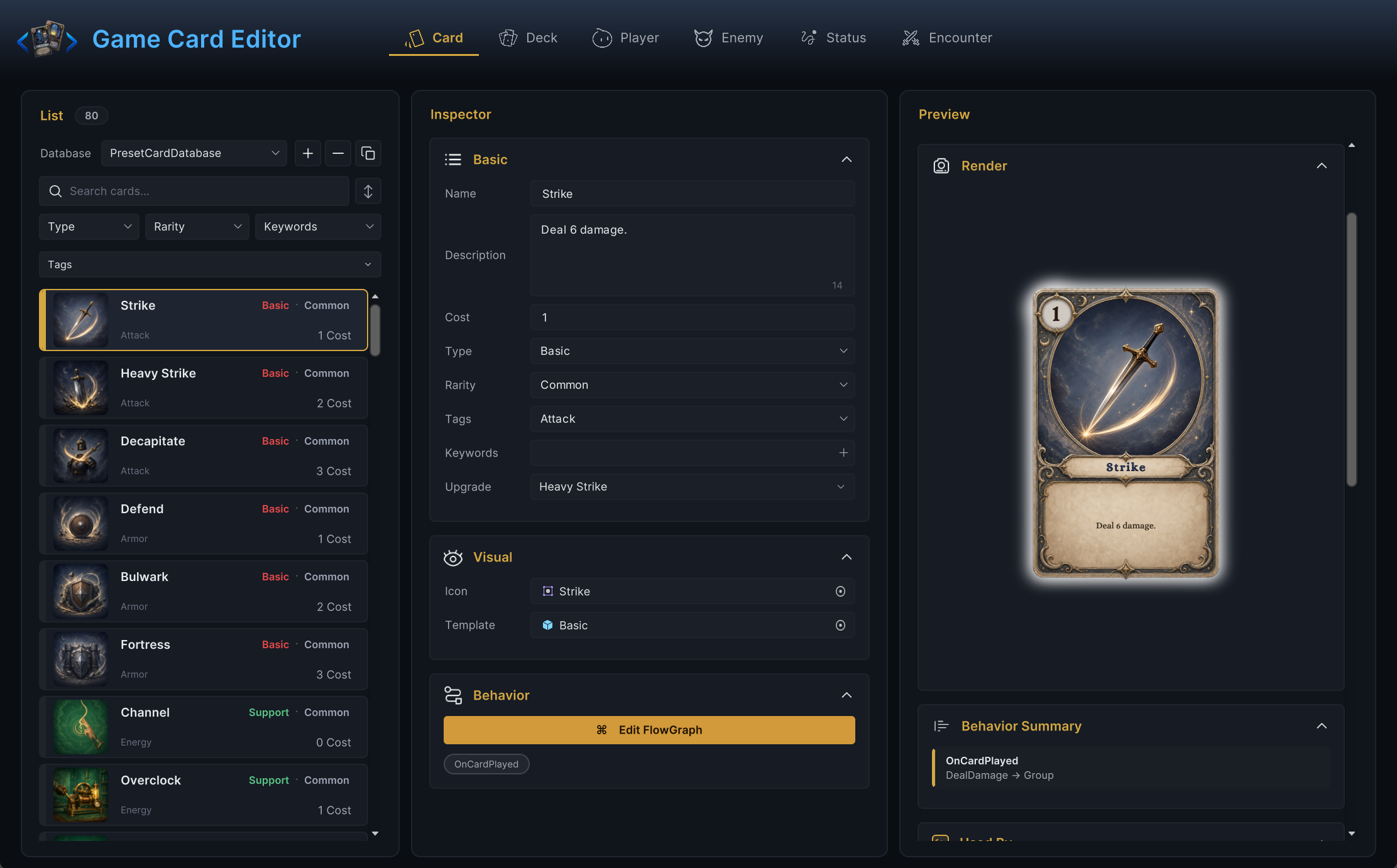
Databases
| Database | Current content |
|---|---|
PresetCardDatabase | 80 cards |
PresetDeckDatabase | 16 decks |
PresetStatusDatabase | 30 statuses |
PresetEnemyUnitDatabase | 16 enemy units |
PresetPlayerUnitDatabase | 12 player units |
PresetEncounterDatabase | 12 encounters |
Cards
The 80 cards split into 28 neutral basics plus 13 cards for each of the four classes. A few names to search for in Card mode:
| Set | Example cards |
|---|---|
| Hunter | Quick Shot, Poison Arrow, Bleeding Arrow, Rapid Fire, Hunter's Mark, Volley, Dead Eye, Perfect Shot |
| Warrior | Slash, Shield Bash, Rally, Iron Wall, Demon Form |
| Mage | Fire Bolt, Frost Shard, Meteor Strike, Arcane Nova |
| Priest | Judgment, Holy Strike, Sanctuary, Apotheosis |
| Neutral basics | Strike, Defend, Insight, Bandage, Discover, Echo |
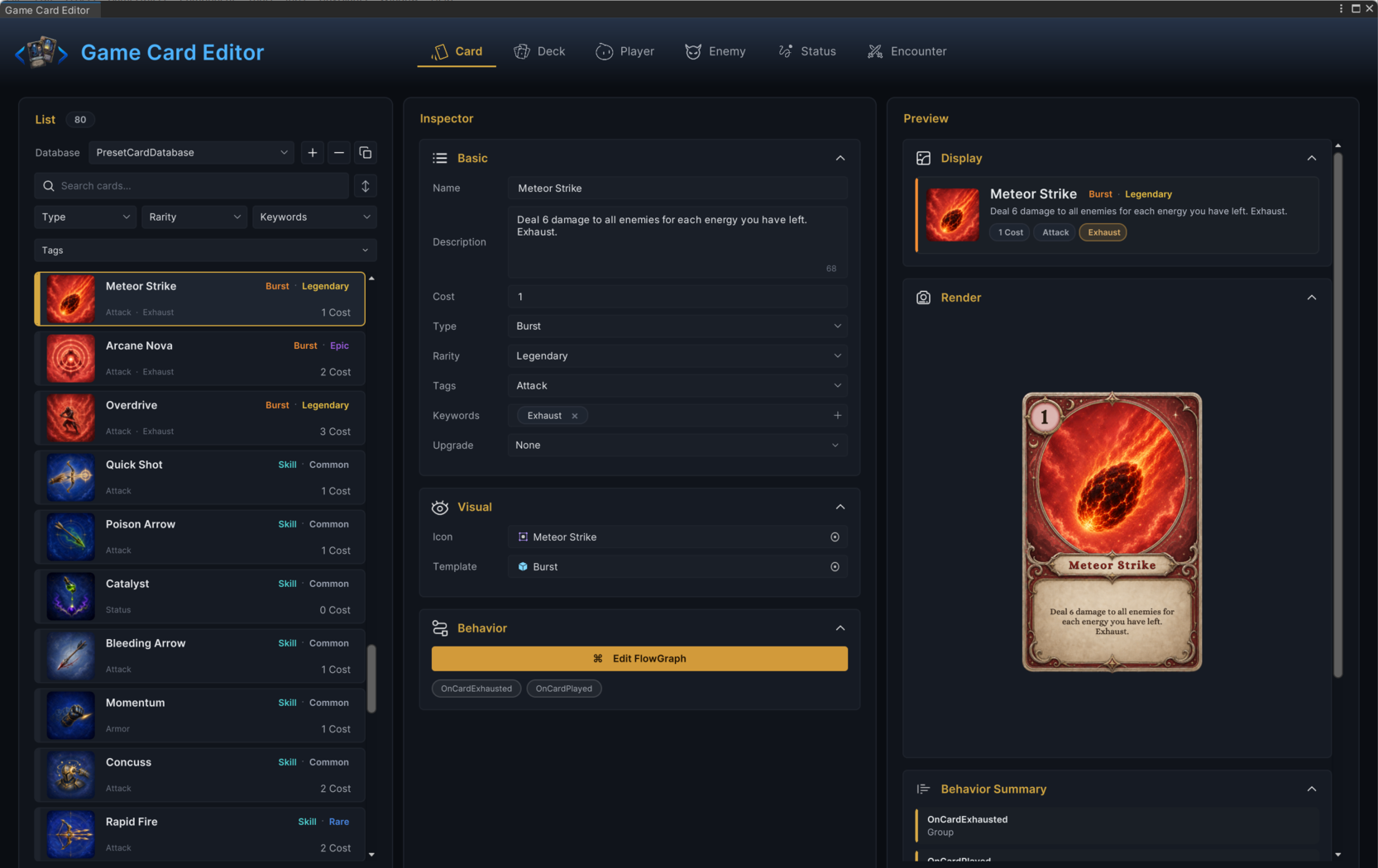
Card definitions (cost, type, rarity, description, Behavior graph) live in the database. The visuals live under Content/Cards/ in five template families: Basic, Skill, Support, Burst, and Curse. Each family folder holds the frame sprite, the card prefab, and an Artwork/ folder with the art of every card that uses that frame.
Poison Arrow and Rapid Fire are good first reads: their graphs are documented step by step in the FlowGraph window page, and each runs about a dozen nodes.
Decks
Each class owns four decks: one starting deck per player tier, plus one reward deck the victory screen draws its card choices from.
| Class | Starting decks (tier order) | Reward deck |
|---|---|---|
| Warrior | Iron Resolve, Steel Onslaught, Bloodforged Fury | Spoils of Battle |
| Mage | Spark of Insight, Arcane Surge, Cataclysm Codex | Hoarded Secrets |
| Hunter | First Hunt, Marked Quarry, Apex Predator | Wild Harvest |
| Priest | Quiet Devotion, Sacred Rites, Divine Ascension | Blessed Offerings |
Decks answer "which cards does this fight start with"; the cards themselves answer "what does each entry do". Read them in that order when reverse-engineering a battle.
Statuses
The 30 statuses cover the patterns most card games need. Grouped loosely by what they do:
| Pattern | Statuses |
|---|---|
| Damage over time and pressure | Burn, Bleed, Poison, Thorns |
| Debuff and control | Vulnerable, Weak, Frail, Stunned, Silence, Restricted, Frozen, Confused |
| Defense and sustain | Plated Armor, Holy Shield, Buffer, Metallicize, Regeneration, Intangible, Lifesteal |
| Scaling and resources | Strength, Dexterity, Empower, Energized, Artifact, Reflect, Marked, Ritual |
| Special state | Curse, Wet, Drained |
Open any of them in Workbench Status mode to see its stacking rule, decay rule, tags, and Behavior graph. Poison is the canonical example: its graph is small, and you can watch it tick in a Hunter battle.
Units and encounters
Player units come in three tiers per class, each linked to its starting deck from the table above:
| Class | Player units (Normal / Elite / Boss scene) |
|---|---|
| Warrior | Squire, Knight, Warlord |
| Mage | Apprentice, Conjurer, Archmage |
| Hunter | Scout, Ranger, Huntmaster |
| Priest | Acolyte, Cleric, Hierophant |
The enemy roster is also four per class, tiered Normal, Elite, Boss, and Summon:
| Class | Normal | Elite | Boss | Summon |
|---|---|---|---|---|
| Warrior | Strawman | Pyre Effigy | Gibbet Priest | Stitched Hound |
| Mage | Hex Acolyte | Candle Magus | Ashen Hierarch | Hex Hound |
| Hunter | Plague Stalker | Spore Brute | Mire Reaper | Bog Polyp |
| Priest | Lantern Sister | Order Knight | Gilded Bishop | Stringed Squire |
Summon-tier enemies never appear in an encounter lineup. They join fights through Spawn Unit nodes in other enemies' behavior graphs.
An encounter binds all of this together: name, description, difficulty, icon, player unit, enemy lineup, reward deck, tags, and a battle-rule block. The Threshing Field (Warrior Normal) is a compact example: Squire (HP 70, Energy 3) against a Strawman (HP rolled between 14 and 18), rewarded from Spoils of Battle, with rules of hand size 5, draw 5 per turn, hand max 10, 3 reward choices, armor reset on turn start, and discard on turn end.
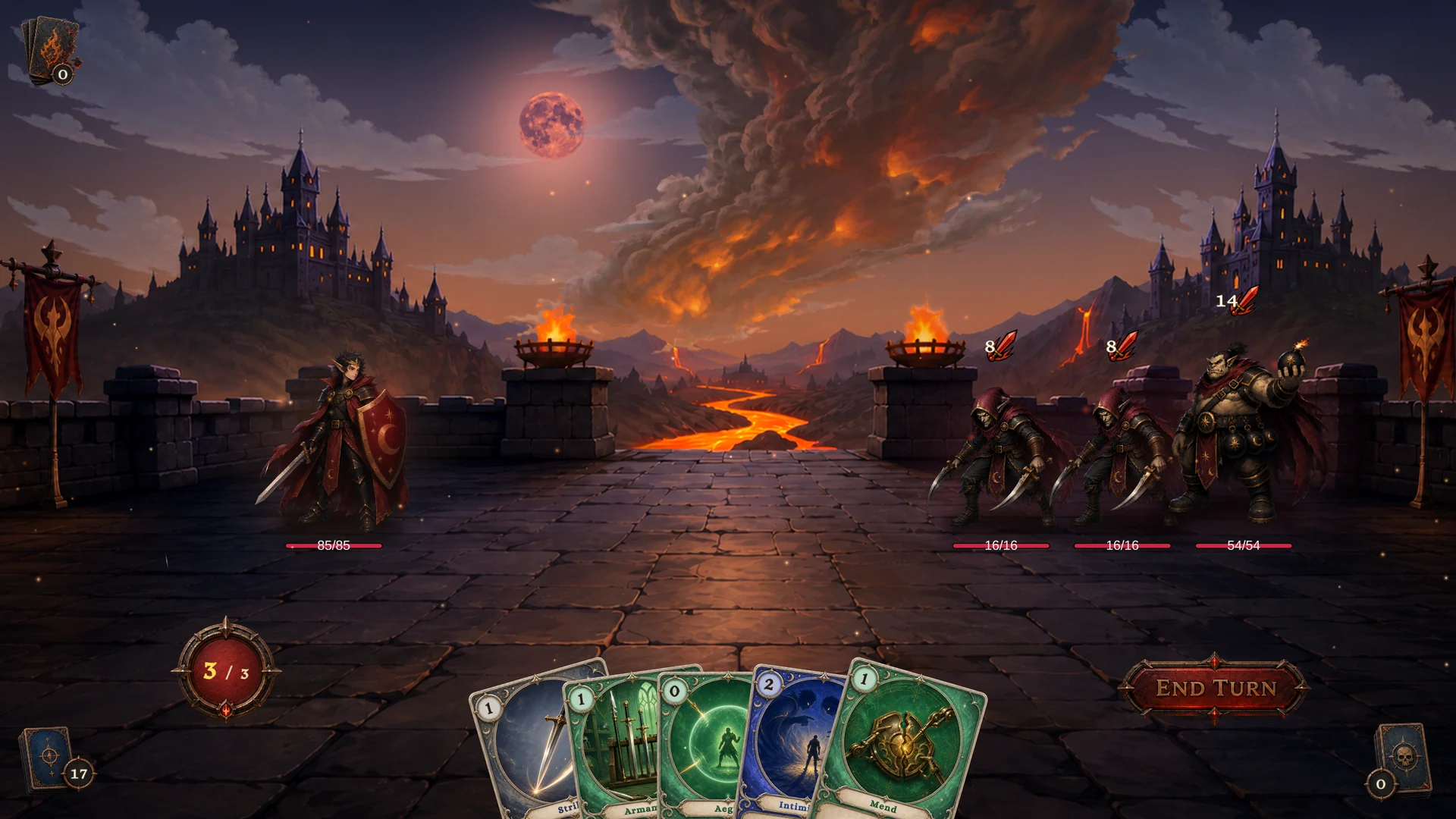
The 12 encounter names match the 12 demo scenes one to one, and the scene page lists every lineup. This is what one looks like in play:
Using the roster as a pattern source
Reuse structures, not preset rows. Rebuild a card graph on your own card instead of duplicating the demo card; reuse a status decay pattern and rebalance it under a new name; take an enemy's intent structure and swap the units and numbers; reuse an encounter's rule block but point it at project-owned content. Mixing preset definitions into a production database means sample content ships with your game.