Data Model Reference
The six authorable asset families, the runtime battle types created from them, and the rule for who may mutate battle state.
For anyone deciding which type to reference, read, or leave alone when writing integration code.The GCS data model splits into two halves. Assets are what you author in the Game Card Editor and store in databases. Runtime models are what a battle builds from those assets the moment it starts. Keeping the two apart answers most "where does this value live" questions before they become bugs.
Authorable assets
Six content families cover everything you can author:
| Type | User-facing responsibility |
|---|---|
GameCard | A playable card definition: cost, type, target mode, keywords, tags, artwork, and behavior. |
GameStatus | A buff, debuff, or reactive rule: stack policy, decay, icon, tags, behavior. |
GameEnemyUnit | An enemy definition: HP range, tier, tags, prefab, intent behavior. |
GamePlayerUnit | A player definition: HP, energy, class identity, prefab, starting deck. |
GameEncounter | A battle setup: player, enemies, reward deck, battle rules, display data. |
GameDeck | A list of card entries (card plus copy count) used as starting or reward content. |
The two unit families share one base, GameUnit, so a player unit and an enemy carry the same identity fields: Name, Description, Icon, Template prefab, and Tags. What differs is the stat block. A GamePlayerUnit has a fixed Base HP and Base Energy; a GameEnemyUnit has an HP Min / HP Max range and a Tier.
Each family has a matching database asset: GameCardDatabase, GameStatusDatabase, GameEnemyUnitDatabase, GamePlayerUnitDatabase, GameEncounterDatabase, and GameDeckDatabase. A database is a container of definitions. Registering it on the scene GameCardManager is what makes its content reachable at runtime.
Where behavior lives
GameCard, GameStatus, and GameEnemyUnit each embed a flow graph directly in a field named Behavior. There is no separate behavior asset to create, link, or lose. The other three families carry no graph: an encounter describes the setup, a player unit acts through its cards, and a deck is just a card list.
If you are looking for "the encounter's graph", it does not exist. Effects always belong to a card, a status, or an enemy. Encounter-wide rules are plain fields on BattleRules, not nodes.
Runtime models
When GCSApi.StartBattle runs, GCS builds this runtime layer from the authored definitions:
| Type | Runtime meaning |
|---|---|
IBattleState | Read-only battle view: phase, units, piles, energy, turn, active encounter. |
IBattleController | The supported mutation gateway for battle state. |
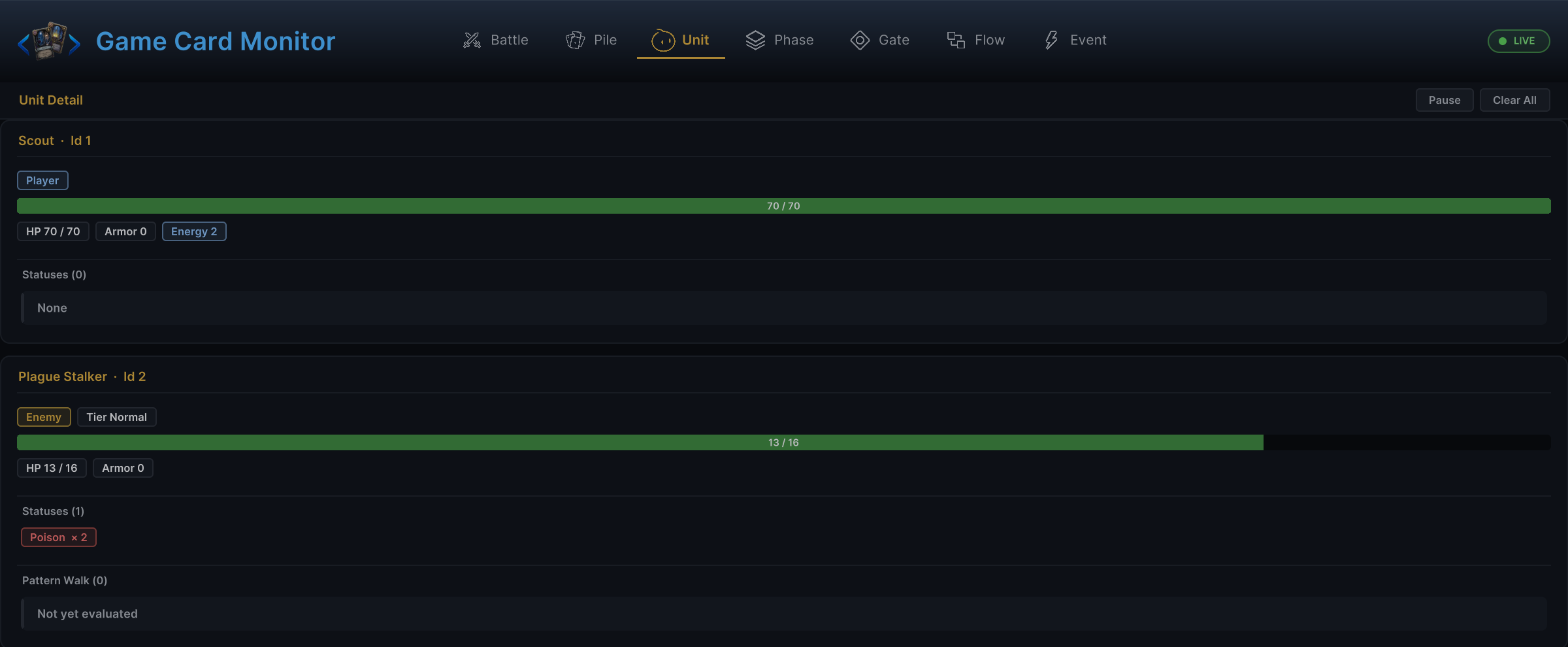
UnitState | Live state for one unit: current HP, armor, statuses, flags. |
EnemyUnitState | Enemy-specific UnitState with intent and behavior context. |
CardInstance | One card copy inside a battle pile, with its own instance id and upgrade flag. |
CardPile | A runtime pile: hand, draw, discard, or exhaust. |
CardCostRule | A cost change applied to one card instance, either permanent or expiring after a set number of turns. |
GCSApi | The public entry point for battle control, events, and the content registries. |
The Monitor window shows this layer live. If a value appears there (current HP, armor, stacks, pile contents), it is runtime state, not something you edit on the asset.
Definitions vs instances
Definitions are authored content. Instances are the copies a battle makes from them.
| Concept | Example | Do not confuse with |
|---|---|---|
| Card definition | A GameCard named Strike | The CardInstance currently in hand. |
| Unit definition | A GameEnemyUnit named Strawman | That enemy's current HP and armor in battle. |
| Status definition | A GameStatus named Burn | A unit's current Burn stack count. |
| Deck definition | A GameDeck | The runtime draw, discard, and exhaust piles. |
Instance state is created once, at battle start. An enemy rolls its HP from the definition's range (both ends inclusive) and keeps that roll; a deck's entries become CardInstance copies in the draw pile, one per copy count. Editing a definition during Play Mode does not rewrite state that was already created from it.
The mutation rule
Never mutate runtime objects directly from your own code. Three supported paths exist:
GCSApifor external C# integration.ctx.Controllerinside custom FlowGraph nodes.- Built-in FlowGraph nodes for authored effects.
Setting UnitState HP by hand, or inserting into a CardPile yourself, skips hooks, events, presentation updates, and Monitor output. The battle keeps running, but statuses stop reacting and the UI stops matching the state. Route every change through a controller method instead.
Internal-only types
Some runtime and editor classes are implementation details. If a type is not exposed through the authoring UI, GCSApi, the public node bases, event args, or a documented registry, treat it as internal even when C# lets you reach it. Internal types can change shape between versions; the documented entry points will not.