Get Nodes
Read units, cards, statuses, piles, variables, event arguments, and live battle values.
Get nodes only provide data. They have no control ports and do not advance execution; connect their outputs directly to Action, Operator, Flow, or FX data inputs.Get nodes only provide data. They have no control ports and do not advance execution; connect their outputs directly to Action, Operator, Flow, or FX data inputs.
Node Usage
Active Team
Use Active Team when a branch or condition needs to know which side currently owns the turn.
Input
- —:No input ports
Output
Team(String):Playerduring the player turn,Enemyduring the enemy turn, orUnknownwhen no battle is active
Fields: none.
The result describes the active side, not the team of the graph owner or a selected target.

Active Turn
Use Active Turn for turn-based scaling, first-turn rules, or conditions that run every few turns.
Input
- —:No input ports
Output
Turn(Int):The battle's current turn number, or0outside battle
Fields: none.
Turn is the battle counter. It is not a per-unit action count and does not tell you how many times a particular enemy has acted.

Active Unit
Use Active Unit when a rule follows the side whose turn is currently running rather than the graph owner.
Input
- —:No input ports
Output
Unit(UnitRef):The player unit on the player turn, or the first living enemy on the enemy turn
Fields: none.
In a multi-enemy encounter, Active Unit does not identify the enemy whose behavior is currently executing; it returns the first living enemy. Use the entry context or an explicit target when that distinction matters. The output is null when no matching unit is available.

Self Unit
Use Self Unit for effects that must read or affect the unit that owns the current graph.
Input
- —:No input ports
Output
Unit(UnitRef):The execution context's graph owner
Fields: none.
Self Unit is tied to the graph host, not the active side. It returns null if the execution context has no unit host.

Opponent Unit
Use Opponent Unit as a compact default target for simple player-versus-enemy behavior.
Input
- —:No input ports
Output
Unit(UnitRef):The first living enemy when the host is the player; otherwise the player unit
Fields: none.
This node does not read the card's chosen target. In encounters with several enemies, it always resolves the first living enemy for a player-owned graph. Use an explicit target or collection workflow when target selection matters.

Player Energy
Use Player Energy for affordability checks or effects that scale from the player's current energy.
Input
- —:No input ports
Output
Current(Int):Energy currently available to the playerPerTurn(Int):BaseEnergyfrom the activeGamePlayerUnit; falls back to current energy if that definition is unavailable
Fields: none.
Both outputs return 0 outside battle. PerTurn is the player asset's base value, not the final energy that a future turn will receive after hooks or run-level adjustments.
Unit collections and inspection

All Enemies
Use All Enemies for area effects, filters, random enemy selection, and Foreach loops.
Input
- —:No input ports
Output
Units(UnitCollection):A fresh list containing every living enemy
Fields: none.
Defeated enemies are excluded. The node returns an empty collection, never null, when no enemy is alive or no battle is active.

All Units
Use All Units for board-wide rules that intentionally include both teams.
Input
- —:No input ports
Output
Units(UnitCollection):A fresh list containing the living player first, followed by all living enemies
Fields: none.
The player is omitted when defeated. Use All Enemies when friendly units must not enter the downstream collection.

Unit Info
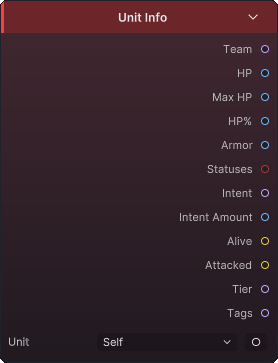
Use Unit Info to drive conditions, filters, intent logic, or presentation from one unit's live state.
Input
Unit(UnitRef):Optional exposed input; overridesUnitSourcewhen connected
Output
Team(String):Player,Enemy, orUnknownHP(Int):Current HPMaxHP(Int):Maximum HPHPPercent(Int):Current HP as an integer percentage from0to100Armor(Int):Current armorStatuses(StatusCollection):Status assets currently present on the unitIntent(String):Current enemy intent tag, orUnknownfor a non-enemyIntentAmount(Int):Current enemy intent value, or-1when no value appliesAlive(Bool):Onwhen the unit exists and is not deadAttacked(Bool):Whether the unit was attacked during the current turnTier(String):Enemy tier, or an empty string for other unitsTags(String):The unit definition's tag list
Parameters
UnitSource(Self):Self,Opponent,AllEnemies,AllUnits;Selects the unit whenUnitis not connected
The node reads one unit. AllEnemies and AllUnits therefore resolve only their first item. If no unit resolves, numeric outputs are 0, text outputs use their empty or unknown value, Statuses and Tags are empty, and Alive is off. The editor currently declares Tags as String, while the runtime value is a read-only list of strings.
Unit Status Stacks
Use Unit Status Stacks when damage, healing, branching, or status consumption depends on one status's current stack count.
Input
Unit(UnitRef):Optional exposed input; overridesUnitSourcewhen connected
Output
Stacks(Int):Current stacks of the selected status on the resolved unit
Parameters
UnitSource(Self):Self,Opponent,AllEnemies,AllUnits;Selects the unit whenUnitis not connectedStatus(None):AnyGameStatusasset;Selects the status to count
This is a single-unit lookup, so collection sources contribute only their first unit. Stacks is 0 when the unit or Status field is missing, or when the unit does not have that status.

Status Info
Use Status Info inside a status graph, or connect a status explicitly when a rule needs its type, tags, or stacks on the graph owner.
Input
Status(StatusRef):Optional status override
Output
Stacks(Int):Stacks of the resolved status on the graph hostType(String):BufforDebuff; empty when no status resolvesTags(String):The resolved status definition's tag list
Parameters
Status(None):AnyGameStatusasset;Fallback status when the input is not connected
Resolution order is connected Status, inline Status, then the execution context's current status. Stacks always checks the graph host, not an arbitrary target, and returns 0 without both a host and a resolved status. The editor currently declares Tags as String, while the runtime value is a read-only list of strings.
Cards and piles

This Card
Use This Card when a card behavior needs the exact runtime card instance that owns the execution.
Input
- —:No input ports
Output
Card(CardRef):The current card instance
Fields: none.
The editor only allows this node in a card-owned graph. It returns null when execution has no current card instance.

Card Info
Use Card Info for cost checks, card-type branches, rarity rules, and tag or keyword synergies.
Input
Card(CardRef):Optional exposed input; overridesCardSourcewhen connected
Output
Cost(Int):Effective energy cost for a runtime instance, or the asset's base cost when only a definition is availableType(String):Card typeRarity(String):Card rarityTags(String):Card tag listKeywords(String):Card keyword list
Parameters
CardSource(ThisCard):ThisCard,HandPile,DrawPile,DiscardPile,ExhaustPile,AllPiles;Selects the card source whenCardis not connected
Card Info reads one card. Pile-based sources therefore use the first resolved card. If no instance resolves, the current played card definition is the final fallback. Missing cards produce 0, empty strings, and empty tag or keyword lists. The editor currently declares Tags and Keywords as String, while both runtime values are read-only lists of strings.

Card Piles
Use Card Piles to feed live battle cards into Filter, Count, Take, Move Cards, or other collection nodes.
Input
- —:No input ports
Output
Cards(CardCollection):The cards selected byPile
Parameters
Pile(Hand):Hand,Draw,Discard,Exhaust,Master,All;Chooses the runtime pile or combined source to read
Hand, Draw, Discard, and Exhaust return the live battle pile views. All creates a collection in hand, draw, discard, then exhaust order; it does not include Master. Master creates temporary instance-ID-0 cards from the current master deck and preserves each entry's upgraded state and cost delta. Outside battle, every option returns an empty collection.

Deck Cards
Use Deck Cards when the graph needs the contents of a particular GameDeck asset rather than the player's live battle piles.
Input
- —:No input ports
Output
Cards(CardCollection):Temporary card instances built from the selected deck's entries
Parameters
Deck(None):AnyGameDeckasset;Selects the deck definition to read
Each deck entry contributes at least one instance: Copies values below 1 are treated as 1. The node creates fresh instance-ID-0 cards and does not read or modify live battle piles. A missing deck or entry list returns an empty collection.

Cards Played This Turn
Use Cards Played This Turn for combo counts and rules that inspect the current turn's play history.
Input
- —:No input ports
Output
Cards(CardCollection):Runtime card instances played this turn, in play order
Fields: none.
The history resets with the turn and is not a whole-battle log. Outside battle, the node returns an empty collection.

Cards Drawn This Turn
Use Cards Drawn This Turn for draw-count bonuses and rules that inspect which cards entered the hand during the current turn.
Input
- —:No input ports
Output
Cards(CardCollection):Runtime card instances drawn this turn, in draw order
Fields: none.
This is draw history, not the current hand. Cards can leave the hand and remain in this collection until the turn changes. Outside battle, the node returns an empty collection.
Variables and event data

Variable
Use Variable with Set Variable when a later node or another entry needs a named value instead of a direct wire.
Input
- —:No input ports
Output
Result(Any):The named value converted to the selectedKind
Parameters
Name(Empty):Any matching variable name;Identifies the value written bySet VariableKind(Int):Int,Float,Bool,Unit,Card,Status;Selects the stored value type and the default returned when missingBattleScope(Off):Off, On;Off reads the current graph execution; On reads the battle-wide store shared by entries
The name and scope must match the writer. A missing value returns the selected type's default: 0, 0.0, off, or null. Execution-scoped values do not survive into a separate entry; enable BattleScope only when that sharing is intentional.

Event Arg
Use Event Arg in a graph started by an internal-event or GES-event entry to read one named value from that event payload.
Input
- —:No input ports
Output
Result(Any):The event argument stored underArgName
Parameters
ArgName(Empty):A key supplied by the event;Selects which payload value to read
Argument names are exact. The result is null when the graph was not started by an event, the event did not include that key, or the name does not match.
