Flow Nodes
Control when and in what order connected nodes run.
Flow nodes route control connections. Use them to branch, repeat, wait, sequence, or pause execution; they do not replace Operator nodes that calculate data values.Flow nodes route control connections. Use them to branch, repeat, wait, sequence, or pause execution; they do not replace Operator nodes that calculate data values.
Node Usage
Sequence
Runs each step from top to bottom. Use it when one trigger must start several independent branches in a fixed order, such as applying damage, updating a status, and then playing presentation effects.
Inputs
In(Control):Starts the sequence
Outputs
Step0…StepN(Control):Runs once each, in numeric order; the number of ports followsOutputs
Parameters
Outputs(Integer):2;Number of ordered step ports; increasing or decreasing it rebuilds the visible outputs
Steps are started in numeric order. A fully synchronous path finishes before the next step starts, but a path that reaches Wait or Choice returns at that boundary, so later steps can start before the delayed or chosen branch continues. Use Branch or Switch instead when only one of several paths should run.
With Outputs set to 0 or less, the node has no step path to run.

Branch
Chooses one of two control paths from a boolean value. A common connection is Condition.Result → Branch.Condition.
Inputs
In(Control):Evaluates the branchCondition(Boolean):trueselectsTrue;falseor an unconnected input selectsFalse
Outputs
True(Control):Runs whenConditionis trueFalse(Control):Runs whenConditionis false
Parameters: none
Only one output runs per evaluation. If the false case should simply stop, it is valid to leave False unconnected.

Switch
Routes execution by matching an integer or string against a list of cases. Use it for named states such as card types, intent names, or turn modes where a two-way Branch is not enough.
Inputs
In(Control):Evaluates the casesOn(Integer or String):Value compared withCase Values; its type followsKind
Outputs
Case 1…Case N(Control):One visible port per value, using the same order; serialized internally asCase0…CaseN-1Default(Control):Runs when no case matches; shown with the case outputs afterOnis connected
Parameters
Kind(internal)(Int/String):Intbefore inference;Set automatically from the data type connected toOn; it is not a separate editor selectorCases(Case Values)(Integer or String list):Empty untilOnis connected;The UI count includesDefault; each remaining row stores one case value and creates one visible case output
Matching is exact and case-sensitive for strings. Cases are checked from top to bottom, so the first duplicate wins; an entry that cannot be parsed in Int mode is skipped.
A null string input is treated as an empty string, so it can match an empty string case.
In the editor, connect On before configuring cases or seeing their control outputs. The visible Cases count includes the final Default, so Cases = 3 creates two editable values and the visible outputs Case 1, Case 2, and Default.

Gate
Lets execution continue only while a boolean condition is true. Use it as a compact guard when you do not need a separate false branch.
Inputs
In(Control):Tests the gateAllow(Boolean):Opens the gate when true; false stops this path
Outputs
Out(Control):Runs only whenAllowis true
Parameters: none
An unconnected Allow is false, so the graph stops at the node. Use Branch if both outcomes need behavior.

Loop
Runs the same body a fixed number of times. Connect Index when the current zero-based pass number is useful for scaling, selecting, or display.
Inputs
In(Control):Starts the loopCount(Integer):Number of body executions; falls back to theCountfield
Outputs
Body(Control):Runs once per passDone(Control):Runs after all passes, including when the count is zero or negativeIndex(Integer):Current pass index, starting at0
Parameters
Count(Integer):1;Inspector fallback when theCountinput is not connected
The synchronous part of each Body path completes before the next pass begins. If Body reaches Wait or Choice, the next pass starts after that node returns rather than after its later continuation. Prefer Foreach when you already have a collection and need its actual elements.
Every pass overwrites the same Index result in the shared execution context. If a path waits before consuming Index, its continuation can observe a later pass's value, often the final index; consume or store the value before the asynchronous boundary.

Foreach
Runs once for every item in a unit, card, or status collection. It preserves collection order and exposes both the current item and its zero-based index.
Inputs
In(Control):Starts enumerationCollection(Unit, Card, or Status collection):Items to enumerate; its type followsKind
Outputs
Body(Control):Runs once for each itemDone(Control):Runs after the last item, or immediately for a null or empty collectionElement(Unit, Card, or Status reference):Current item; its type followsKindIndex(Integer):Current item index, starting at0
Parameters
Kind(internal)(Unit/Card/Status):Unitbefore inference;Set automatically from the collection connected toCollection; it is not edited directly
Connect Element to the action inside Body; connecting the whole collection there would repeat the same collection action for every pass.
Null elements are still enumerated: Body runs for that position and Element is null.
As with Loop, reaching Wait or Choice does not hold the enumeration; the next element can begin before that asynchronous continuation resumes.
Foreach iterates the original collection reference rather than a snapshot. Synchronously adding, removing, or moving items in Body can change Count and indexes, causing items to be skipped or newly visited. It also overwrites the shared Element and Index results every pass, so consume or store them before a Wait or Choice boundary.

While
Repeats its body while a boolean condition remains true. Use it only when the body changes the value that the condition reads.
Inputs
In(Control):Starts condition checkingCondition(Boolean):Re-evaluated before every pass
Outputs
Body(Control):Runs whileConditionis trueDone(Control):Runs whenConditionbecomes false
Parameters: none
While must become false synchronouslyIf Body does not make Condition false before it returns, the outer iterator keeps running and can lock the game. An unconnected Body with a true condition is an immediate infinite loop; placing Wait or Choice inside the body is not a safe yield because While continues as soon as that node returns. Use Loop, Foreach, or Delayed Trigger when the next pass belongs to a later frame or turn

Wait
Pauses this control path before continuing. Use Seconds for a timed presentation beat, or Animation when another system releases a named animation gate.
Inputs
In(Control):Starts the waitSeconds(Float):Shown inSecondsmode; overrides the Inspector duration when connectedAnimationId(String):Shown inAnimationmode; overrides the Inspector ID when connected
Outputs
Out(Control):Runs after the scheduled wait finishes, or immediately if no wait can be scheduled
Parameters
Mode(Seconds/Animation):Seconds;Chooses the visible input and wait mechanismSeconds(Float):0.5;Time delay used inSecondsmodeAnimation Id(String):Empty;Gate reason used inAnimationmode
Seconds at 0 or less continues immediately. Animation mode does not inspect an Animator clip or trigger automatically: the presentation layer must already have acquired the matching AnimationGate reason before the node runs. If that reason is not held, execution continues immediately; a held reason resumes when released or after the five-second safety timeout. An empty Animation Id uses Flow Wait as the reason.

Delayed Trigger
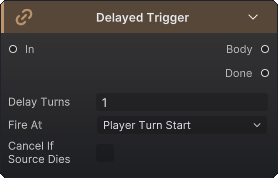
Schedules a connected body for a later battle phase, while the current graph continues through Done. Use it for countdown effects that belong to a future turn rather than for a short visual pause.
Inputs
In(Control):Attempts to register the delayed body
Outputs
Body(Control):Entry point saved for later execution; it does not run during the current passDone(Control):Continues immediately after scheduling
Parameters
Delay Turns(Integer):1;Number of turns before the body is eligible to runFire At(Tick Phase)(PlayerTurnEnd/PlayerTurnStart/EnemyPhaseEnd):PlayerTurnStart;Battle phase that advances and fires the triggerCancel If Source Dies(Cancel On Source Death)(Boolean):Off;Cancels the pending body if its source unit dies
A delayed body is registered only when Body is connected and Delay Turns is greater than zero. With zero or a negative value, the node still follows Done; it does not run Body immediately.
Choice
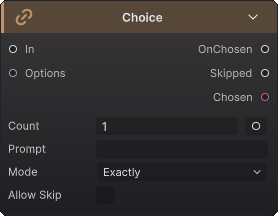
Opens the runtime choice presenter with a collection of units, cards, or statuses, then continues through the selected or skipped path. Use it for decisions the player must make, not for random or automatic selection.
Inputs
In(Control):Opens the choiceOptions(Unit, Card, or Status collection):Candidate list; null entries are omitted and the type followsKindCount(Integer):Declared by the editor, but the current executor does not read this connection
Outputs
OnChosen(Control):Runs after the player confirms a valid selectionSkipped(Control):Runs when the player skips, or when no presenter or candidate is availableChosen(Unit, Card, or Status collection):Confirmed selection, with type followingKind
Parameters
Kind(internal)(Unit/Card/Status):Cardbefore inference;Set automatically from the collection connected toOptions; it is not edited directlyPrompt(String):Empty;Text shown by the choice presenterCount(Integer):1;Maximum picks used by the current runtimeMode(Exactly/UpTo):Exactly;Requires the capped count, or allows any count up to itAllow Skip(Boolean):Off;Allows confirming no selection in the presenter
The effective maximum is clamped to the available candidate count and never below one when candidates exist. UpTo with skipping disabled still requires at least one pick. If the presenter is missing or the candidate list is empty, GCS follows Skipped even when Allow Skip is off.
Count inputThe node exposes a Count data input, but Choice currently reads the Inspector field directly. Set Count on the node until the executor is updated to consume the connected value