Targeting And Selection
Targeting is a contract between three parties: what the card text promises, what the player selects, and what the graph resolves at runtime. This page pins down the exact semantics of each.
Read this before authoring any effect that says 'the enemy', 'all enemies', or 'a random card', so the words mean what the player thinks they mean.The moment targeting starts to matter is the moment there is more than one valid target. Three enemies, three separate intents, and a hand full of cards that each need to know who they hit:
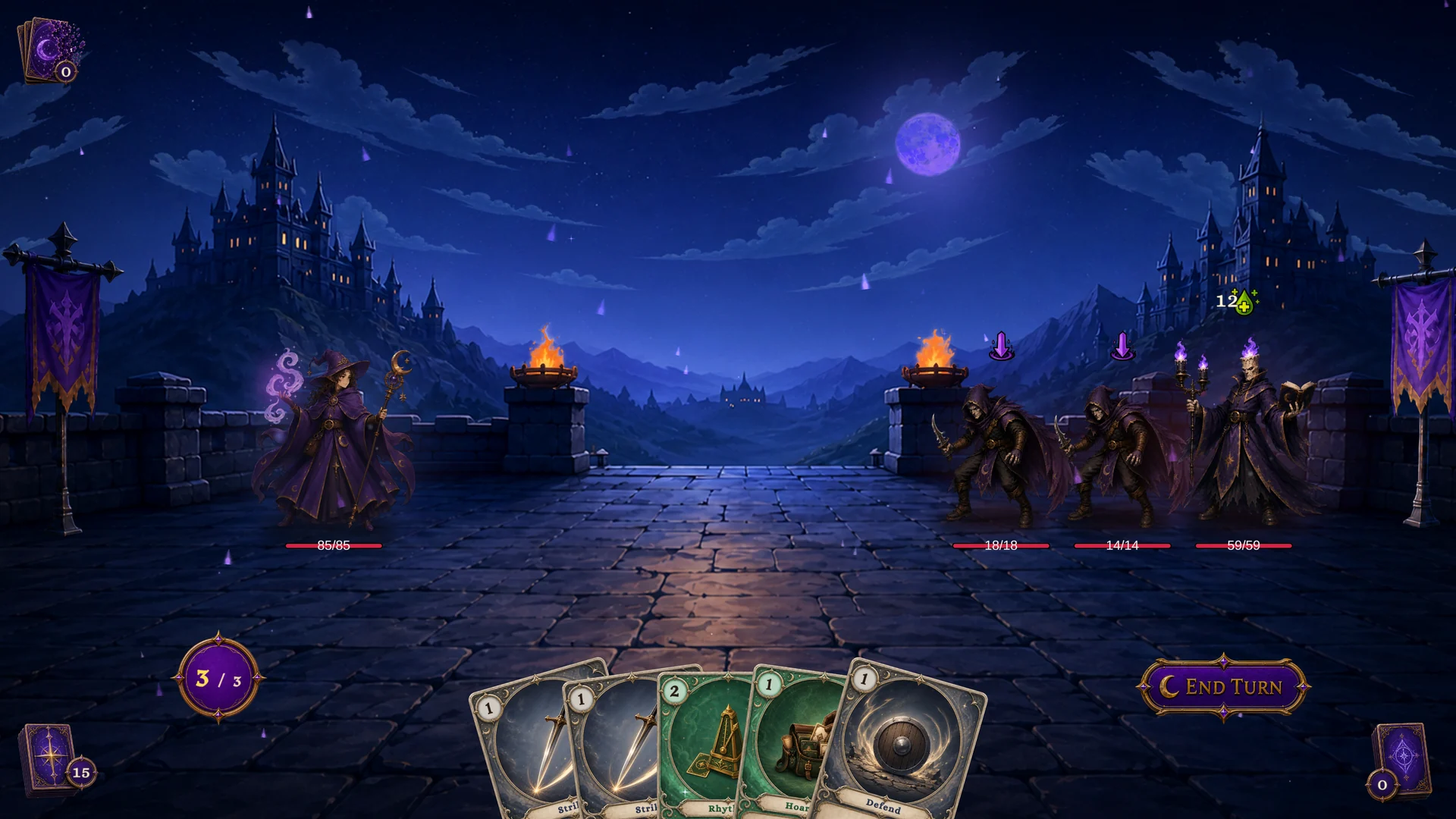
Targeting is the contract between what a card says, what the player selects, and what the FlowGraph resolves. Use the same words in card text, fields, and node names so users never have to guess.
Card target mode
The card's target mode describes player input: what, if anything, the player must click before the card can leave the hand. Exactly one of the four modes asks for a click.
| Mode | Player clicks? | What happens |
|---|---|---|
None | No | The card plays without a selected target. The graph decides everything through its own unit and card sources. |
SingleEnemyUnit | Yes | The card cannot be played until the player selects one living enemy. That clicked enemy becomes the selected target the graph reads through Opponent. |
AllEnemyUnits | No | The card is aimed at every living enemy. Inside the graph, use AllEnemies so the nodes hit the same set the player expects. |
Self | No | The card is aimed at the player unit. Inside the graph, use Self. |
From code, GCSApi.RequiresTarget returns true exactly for SingleEnemyUnit. That is the check a drag-to-target UI uses to decide whether to draw an aiming arrow.
Card target mode is about player input. FlowGraph target sources, below, are about what a node resolves when it runs. The two work together: a SingleEnemyUnit card whose graph uses Opponent hits the clicked enemy. Mixing them up is the most common targeting bug. An AllEnemyUnits card whose only damage node targets Opponent looks like AoE in the hand and hits one enemy on resolve.
Unit source
Nodes that act on units take a UnitSource. The resolution rules are exact, so card text can promise exact things:
| Source | Resolves to |
|---|---|
Self | The unit running the graph: the player on a player card, the holder on a status, the acting enemy on an enemy graph. |
Opponent | When the acting unit is the player (a player card, or a status the player holds): the selected enemy if one was clicked and it is still alive, otherwise the first living enemy. When the acting unit is an enemy: the player unit. |
AllEnemies | Every living enemy. Dead enemies are always excluded. |
AllUnits | The player unit plus every living enemy. Dead units are excluded here too. |
Use Self for block, healing, and self-buffs. Use Opponent for the selected enemy on targeted attacks. Use AllEnemies for AoE cards.
When a node's Target port is connected, the connection supplies the units and the TargetSource dropdown is ignored entirely. Pick the dropdown for the common cases above; reserve the port for computed targets coming out of selector chains.
Card source
Nodes that act on cards take a CardSource:
| Source | Meaning |
|---|---|
ThisCard | The card instance currently resolving. |
HandPile | The current hand. |
DrawPile | The draw pile. |
DiscardPile | The discard pile. |
ExhaustPile | The exhaust pile. |
AllPiles | The four battle piles together: hand, draw, discard, and exhaust. |
Be explicit in card text. "Draw pile" does not mean "all cards", and "hand" means the hand at the moment the node runs, including cards drawn earlier in the same turn.
Selector nodes
When the rule is authored rather than clicked, selectors narrow a collection down. Filter keeps the matching elements (it filters in, not out), Sort orders them, and Pick Element, Take, and Random Elements reduce them to the few you want. Typical builds:
- the lowest-HP enemy:
All EnemiesintoFilter(Alive) intoSort(HP) intoPick Element; - two random cards in hand: a hand collection into
Random Elementswith count 2; - cards filtered by type, rarity, keyword, tag, or a cost threshold;
- units filtered by team, tags, tier, a carried status, HP percentage, or alive state.
Use selectors when the graph should decide. Use card target mode when the player should decide.
No valid target
Built-in action nodes fail soft. Each one resolves its targets, skips anything dead or missing, and continues with whatever remains, which may be nothing at all. A Deal Damage aimed at AllEnemies when no enemy is left alive deals no damage and does not block the battle.
"Do nothing and continue" is the right default. When the empty case matters to the player, make the condition visible instead of relying on the silence:
- put a
Conditioninto aBranchorGatebefore the action; - say it in the card text ("If there is a valid enemy...");
- design the fallback on purpose instead of inheriting whatever the graph happens to do.
Text guidance
Write card descriptions in gameplay language, not in source-enum language:
| Say | Avoid |
|---|---|
| Deal 8 damage to the selected enemy. | Deal 8 to Opponent. |
| Gain 6 armor. | Apply armor to Self. |
| Draw 2 cards from your draw pile. | Move 2 card refs. |
| Apply 2 Burn to all enemies. | Add status to unit collection. |
The implementation can use UnitSource, CardSource, and selectors freely. The card text should describe what the player experiences.